An illustrated guide

What is real?

Common sense says reality is what we can see and touch. David Deutsch argues that reality is whatever our best explanations say exists, and that by that standard it is far larger than anything we see.
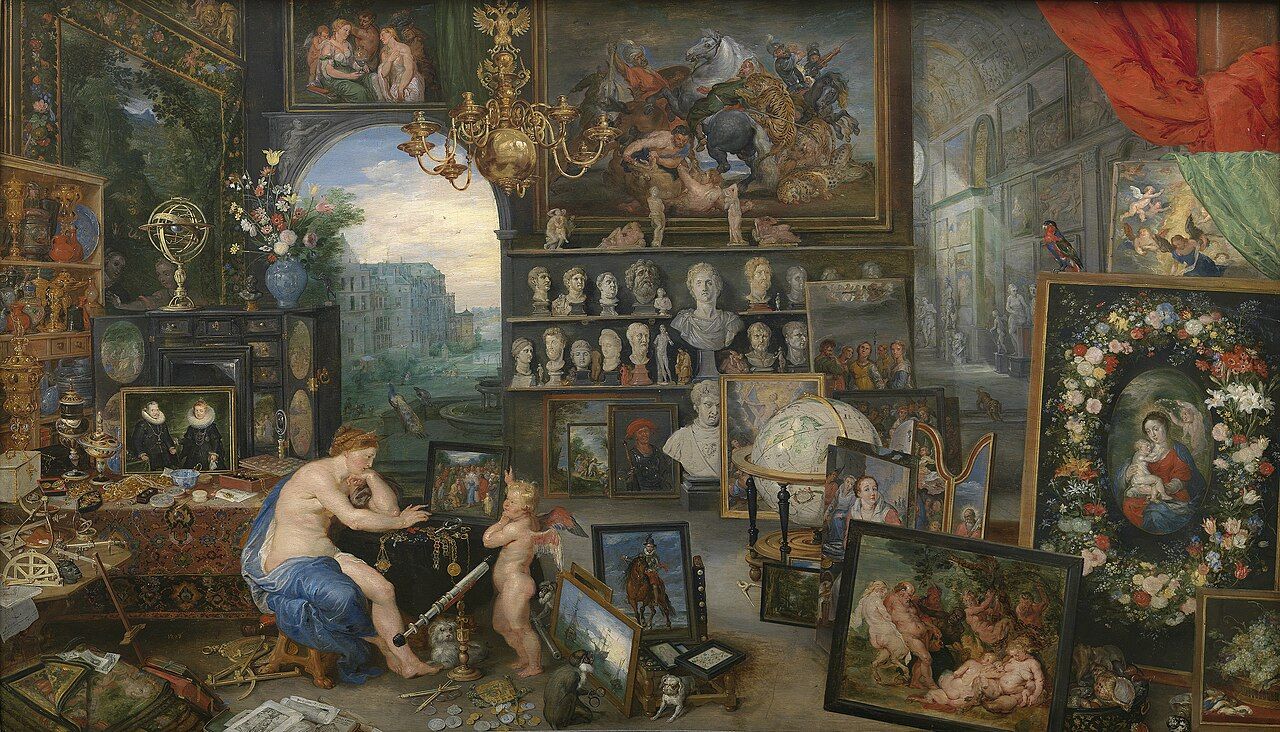
A palatial gallery crammed with paintings, scientific instruments, globes and telescopes, with a seated woman looking at a picture held up by a cherub and a view through arches to a garden beyond
Jan Brueghel the Elder and Peter Paul Rubens, The Allegory of Sight, 1617. Museo del Prado, Madrid. A room full of worlds: paintings within the painting, a telescope, globes and mirrors. Everything here is something seen. The question is what lies beyond the seeing.Public domain, via Wikimedia Commons.

This site starts from Deutsch's first book, The Fabric of Reality (1997), and from the chapters of The Beginning of Infinity (2011) on abstractions, the multiverse and bad philosophy. It asks four questions. What is ultimately real? How do we know? Is there one world or many? And is reality there when nobody is looking?

The answer it defends is Deutsch's. If our best explanation of what we observe refers to something, that thing exists. Quantum interference shows that something we cannot see affects what we can, and the best explanation of it is a multiverse, of which our universe is one layer. Statues, numbers and knowledge are as real as atoms, because they explain what atoms do.

From there, each major view of reality gets a page of its own: what it claims, what drives it, and where it meets and parts from Deutsch. Each has an interactive figure, from Plato's cave to Bell's inequality.

Deutsch's view Seven steps from Johnson's stone to the multiverse, with photons to fire, a beam splitter to block and a domino computer to run. The ancients Parmenides' changeless whole, Democritus's atoms and void, Plato's cave and Aristotle's potentials. Early modern Galileo's mathematical world, Leibniz's possible worlds, Berkeley's idealism and Kant's thing in itself. The quantum century Mach, Einstein and Bohr; Schrödinger's cat, Popper's propensities, Wheeler's bits, Bohm's waves, Bell's theorem and Everett's many worlds. Contemporary Penrose's collapse, Rovelli's relations, Tegmark's mathematics, Wallace's emergent worlds, QBism, and the simulation argument. Compare all views Every thinker in one table: what is real, how we know it, one world or many, and whether it needs an observer. Glossary Realism, instrumentalism, superposition, decoherence, fungibility: the terms of the debate. Reading Books to explore next, with links for UK and US readers.

Why a fifth site

In The Fabric of Reality, Deutsch argues that our deepest understanding rests on four strands, each needed to make sense of the others: Popper's theory of knowledge, Everett's quantum physics, Turing's theory of computation and Darwin's theory of evolution. The knowledge site took on the first strand directly. The time, mind and free will sites drew on the other three without setting them out. Each assumed an answer to a question none of them asked outright: what is there? This site asks it, and its last section draws the five sites together.

Sister site: Philosophy of Time Does time flow? Deutsch's snapshots set against the Greeks and today's philosophers and physicists. Sister site: Philosophy of Mind Is consciousness a magic trick? Daniel Dennett set against thinkers from Aristotle to Popper and Deutsch. Sister site: Philosophy of Free Will Could you have done otherwise? Dennett's compatibilism set against thinkers from the Stoics to Sapolsky. Sister site: Philosophy of Knowledge Where does knowledge come from? Deutsch and Popper set against thinkers from Xenophanes to the Bayesians.