Pisa, Padua and Florence, 1564–1642
Galileo Galilei
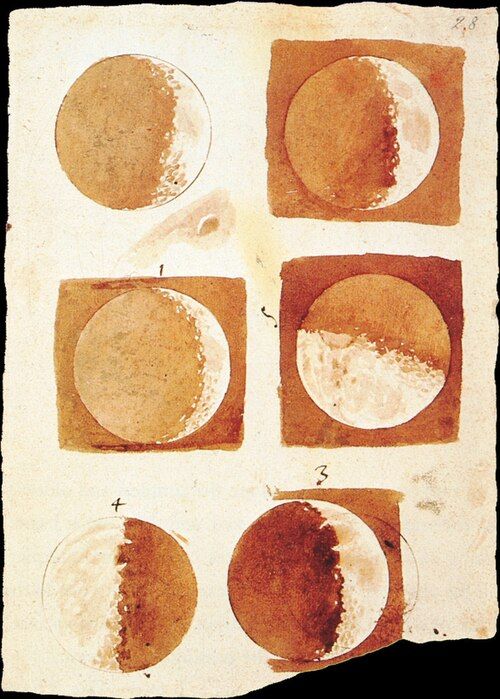
Galileo turned a telescope on the Moon and found mountains. He turned his mind on the senses and found that most of what they report is not in the world at all.
The view
In The Assayer (1623), a polemic about comets, Galileo stopped to say what he thought matter was. When he imagines a body, he must think of it as bounded and shaped, large or small, in one place or another, moving or still, one or many. No effort of imagination can separate a body from those. But he can easily imagine it without colour, taste, smell or sound. Those qualities, he concluded, are not in the body at all. They are names for what bodies do to our senses.
He gave the example of tickling. Draw a feather across a statue's lips and nothing happens; draw it across a person's, and they feel a tickle. Nobody thinks the tickle is in the feather. Heat, colour and taste are the same: real effects in us, of shapes and motions in things.
Philosophy is written in this grand book, the universe, which stands continually open to our gaze; it is written in the language of mathematics. Galileo, The Assayer (1623), our translation
The argument
The division followed from the method. If the world is to be understood mathematically, the qualities that matter must be ones mathematics can handle: quantities, figures, motions. Galileo's laws of falling bodies describe distances and times, not the colour of the ball. What could not be measured was moved into the mind of the observer, and physics was free to get on with the rest.
It worked spectacularly. The telescope, the law of fall and the analysis of projectiles all came from treating the world as matter in motion. John Locke later called the two kinds of quality primary and secondary, and the distinction became the starting point of modern philosophy of perception.
Where he meets Deutsch
Galileo stands at the start of the tradition Deutsch defends. He showed that the heavens obey the same laws as the Earth, that authority is no argument, and that reality can be unlike appearance in ways only theory can reveal. Deutsch's realism is Galileo's realism, carried into the quantum domain.
His remark that the universe is written in mathematics also points towards Deutsch's view that the laws of physics and the laws of computation are deeply linked: the world is the kind of thing that a mathematical description can render.
Where they part
Galileo's cut put colour, taste and feeling outside physics, and left them with nowhere to go but the mind. That created the modern mind–body problem, and it made only the measurable fully real. Deutsch's criterion is more generous. Colour as we experience it may be a matter for a theory of mind, but colour as a property that explains which surfaces reflect which light is as real as shape.
And Deutsch would turn the book image round. Mathematics is not the language the universe happens to be written in. The world allows mathematics, because the laws of physics allow physical objects, such as brains and computers, to reason about it. Which mathematical truths we can know depends on physics, not the other way about.
| Galileo | Deutsch | |
|---|---|---|
| What is ultimately real? | Matter with shape, size, number, position and motion. Colours, tastes and smells are in us. | Whatever our best explanations refer to: the multiverse, and emergent and abstract things too. |
| How do we know what is real? | By experiment and mathematical reasoning together, not by authority. | Conjecture and criticism. If our best explanation needs it, it exists: if it kicks back, it is real. |
| One world or many? | One world, though far larger and less special than Aristotle's. | Many. Our universe is one layer of a multiverse, revealed by quantum interference. |
| Is reality independent of observers? | Yes, for the primary qualities. The secondary qualities vanish without a perceiver. | Yes. Observers are physical systems inside reality, governed by the same laws. |
Further reading
- Galileo Galilei, The Assayer (1623), in Discoveries and Opinions of Galileo, translated by Stillman Drake (1957).
- Galileo Galilei, Sidereus Nuncius (1610), the report of the telescope's first discoveries.
- David Deutsch, The Fabric of Reality (1997), chapter 10, which takes up Galileo's book of nature.
- Galileo Galilei, Stanford Encyclopedia of Philosophy.