Athens, c. 428–348 BC
Plato
Plato told the most famous story in philosophy about appearance and reality. Prisoners chained in a cave take shadows on a wall for the whole of the world. One is freed, turns round, and climbs out into the sun.
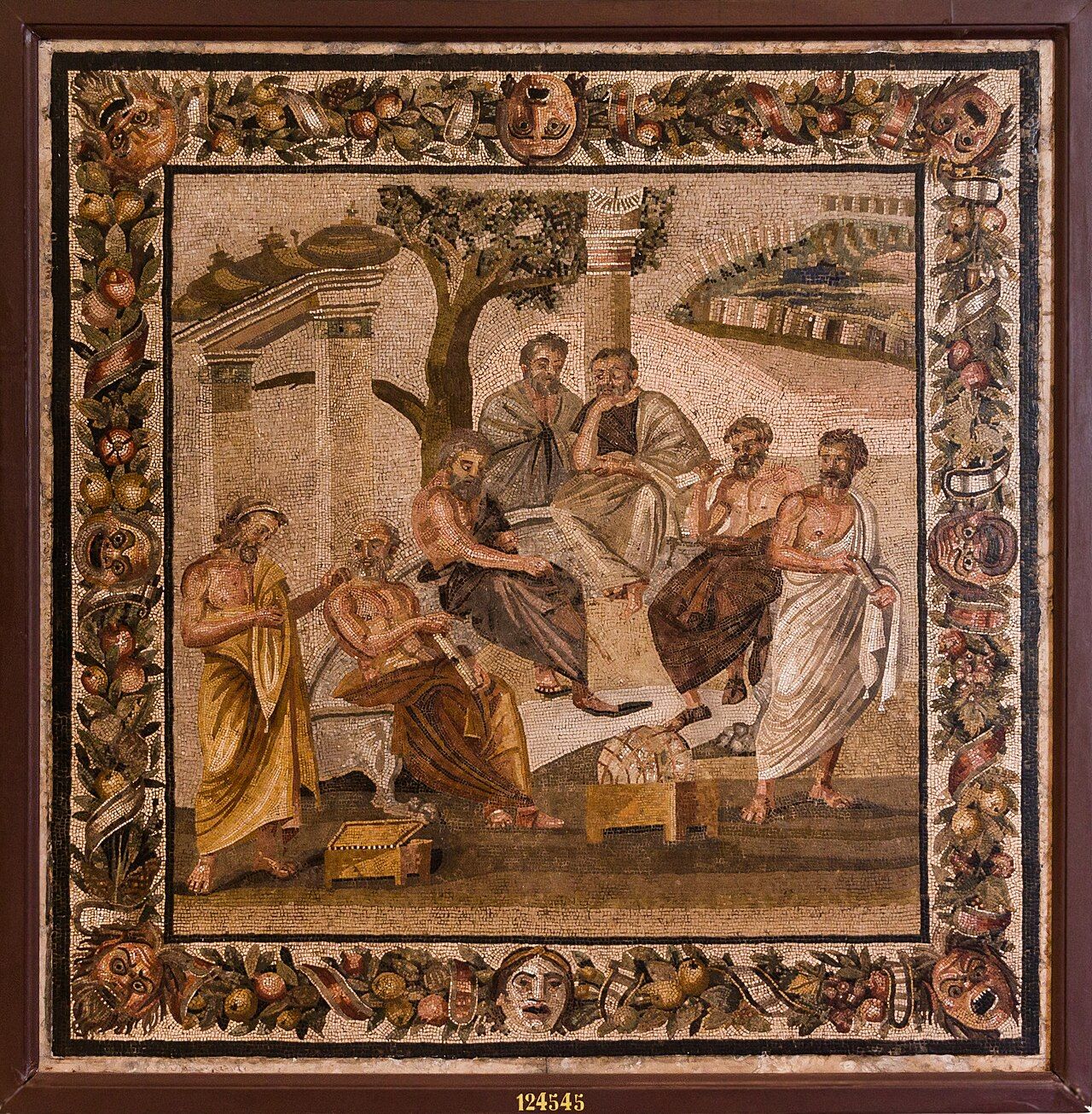
The view
In book VII of the Republic, Socrates asks his listeners to imagine people who have lived all their lives chained in a cave, facing a wall. Behind them a fire burns, and between the fire and the prisoners, people carry objects along a low wall, like puppeteers. The prisoners see only the shadows of the objects, hear echoes of the voices, and take these for reality. They hold contests over who can best predict which shadow will come next.
One prisoner is freed and made to turn round. The fire dazzles him, and at first the objects seem less real than the shadows he knew. Dragged up the steep path into the daylight, he sees first reflections, then things themselves, and at last the sun, which makes everything visible and causes the seasons and the years. If he went back down to free the others, Socrates says, they would laugh at him, and kill him if they could.
They would think that the truth is nothing other than the shadows of the artefacts. Plato, Republic 515c, our translation
The argument
The cave is an allegory, and Plato explains it. The cave is the visible world; the journey up is the soul's ascent to the intelligible world; the sun is the Form of the Good. Particular things, a beautiful face, a just law, two sticks of equal length, are imperfect and changing. Yet we recognise them as beautiful, just and equal. So we must already have some grasp of perfect beauty, justice and equality, which we never met in experience. These Forms are what is truly real, and physical things are real only to the extent that they share in them.
Mathematics was Plato's model. No drawn circle is perfectly round, yet geometers prove truths about the circle, and the truths hold exactly. Whatever they are about, it is not the chalk.
Where he meets Deutsch
Deutsch is a realist about abstractions, and Plato was the first. Numbers, proofs and mathematical truths exist independently of us; we discover them rather than invent them; and they are needed to explain what physical things do. The prisoners' contest is a fair picture of instrumentalism, too: people rewarded for predicting the shadows, with no interest in what casts them.
Deutsch also gives the cave a twist Plato could not. The shadows on the wall are evidence. Reason about them carefully, as with the dark bands of the double slit, and they tell you there is something you cannot see.
Where they part
Plato put abstractions in a separate realm, outside space and time, reached by the soul recollecting what it knew before birth. Deutsch's abstractions are not elsewhere. They are real because they make a difference here, to what dominoes and computers and brains do, and we know them not by recollection but by conjecture and criticism, through proofs that are physical processes and can go wrong.
And Plato despised the visible world as a realm of mere opinion. For Deutsch the physical world is no shadow. It is the most precisely understood part of reality, and the route by which we reach the rest.
| Plato | Deutsch | |
|---|---|---|
| What is ultimately real? | The Forms: eternal, unchanging, perfect patterns, of which physical things are imperfect copies. | Whatever our best explanations refer to: the multiverse, and emergent and abstract things too. |
| How do we know what is real? | By reason and dialectic, which recollect what the soul knew before birth. The senses give only opinion. | Conjecture and criticism. If our best explanation needs it, it exists: if it kicks back, it is real. |
| One world or many? | Two realms, the visible and the intelligible, but one cosmos, made by a craftsman after the eternal model. | Many. Our universe is one layer of a multiverse, revealed by quantum interference. |
| Is reality independent of observers? | Yes. The Forms are what they are regardless of any mind. | Yes. Observers are physical systems inside reality, governed by the same laws. |
Further reading
- Plato, Republic, books VI and VII: the sun, the divided line and the cave.
- Plato, Phaedo, on the Forms and recollection.
- David Deutsch, The Fabric of Reality (1997), chapter 10, on the nature of mathematics.
- Plato's Middle Period Metaphysics and Epistemology, Stanford Encyclopedia of Philosophy.