Kilkenny, Dublin and Cloyne, 1685–1753
George Berkeley
George Berkeley was twenty-five when he published the most radical claim in modern philosophy: there is no matter. Tables, trees and stars are ideas, and their being consists in being perceived.
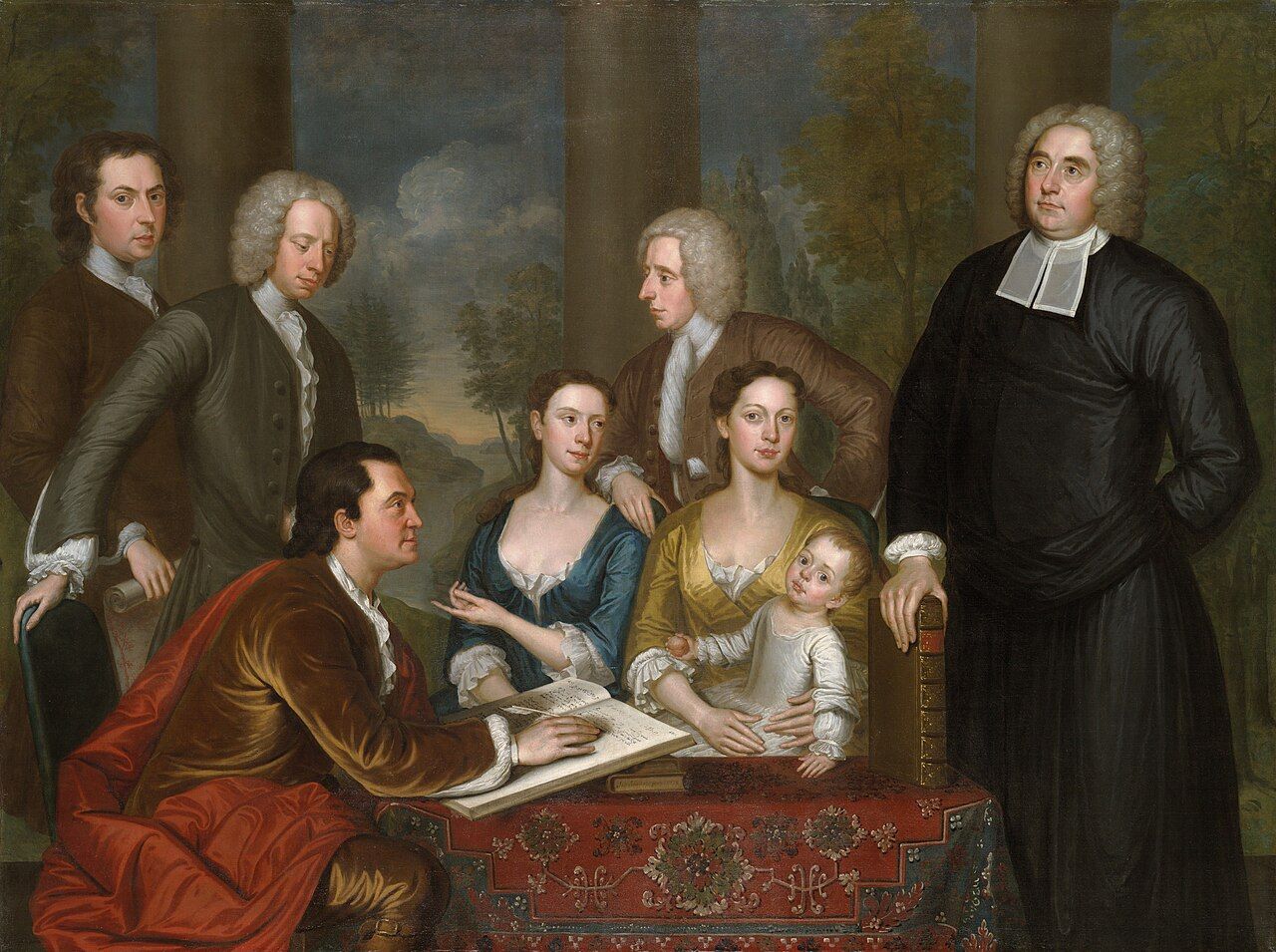
The view
Berkeley began where Galileo and Locke had left off. Colours, tastes and sounds are only in the mind; they had agreed on that. Berkeley asked why the same argument should not apply to shape, size and motion. The apple looks round from one angle and oval from another, large near and small far. If variation shows that colour is in the mind, it shows the same of figure.
Then all we ever perceive are ideas. And the notion of matter, something that has no colour, no taste, no felt shape, and yet is supposed to cause our ideas of them, is not just unknowable. It is incoherent. An idea can be like nothing but another idea.
Their esse is percipi, nor is it possible they should have any existence out of the minds or thinking things which perceive them. Berkeley, Principles of Human Knowledge §3 (1710)
The argument
What then of the tree in the quad when nobody is looking? Berkeley's answer was God. Things go on existing between our glances because they are always perceived by an infinite mind, and the regularity of nature is the regularity of God's will. The laws of physics are real; they describe the order in which God gives us ideas.
He thought this was the common-sense view. Ordinary people believe that the things they see are the real things, and that is exactly what he held. It was the philosophers, with their unseen matter behind the scenes, who had made the world unknowable.
Where he meets Deutsch
Berkeley saw that the problem of the external world is real. We never step outside our perceptions to compare them with the world, and philosophers who assume the world is simply there owe an account of how we know about it. Deutsch takes the problem as seriously. His answer is that we know about the world the way we know about anything: by conjecturing explanations and testing them.
Where they part
Deutsch takes Samuel Johnson's side. Johnson's stone was not just another idea, because it behaved as an independent thing: it resisted, it surprised, it obeyed laws that Johnson had not chosen. Berkeley's reply, that God supplies the resistance, saves the theory by making it easy to vary. Whatever we observe, God could have arranged it. An explanation that accounts for anything equally well accounts for nothing.
The realist explanation does work that Berkeley's cannot. It says why the stone resists, in terms of electrons and fields, and the same terms explain a thousand other things. On Deutsch's criterion, whatever our best explanation of the stone refers to is real. That is matter, or rather the quantum fields that matter turned out to be.
| Berkeley | Deutsch | |
|---|---|---|
| What is ultimately real? | Minds and their ideas. There is no unperceived matter. | Whatever our best explanations refer to: the multiverse, and emergent and abstract things too. |
| How do we know what is real? | By the senses, which give us ideas directly, and by reason about minds, including God's. | Conjecture and criticism. If our best explanation needs it, it exists: if it kicks back, it is real. |
| One world or many? | One world of ideas, sustained by God's perceiving. | Many. Our universe is one layer of a multiverse, revealed by quantum interference. |
| Is reality independent of observers? | No. To be is to be perceived, or to perceive. | Yes. Observers are physical systems inside reality, governed by the same laws. |
Further reading
- George Berkeley, A Treatise Concerning the Principles of Human Knowledge (1710).
- George Berkeley, Three Dialogues between Hylas and Philonous (1713), the same case in livelier form.
- David Deutsch, The Fabric of Reality (1997), chapter 4, "Criteria for Reality".
- George Berkeley, Stanford Encyclopedia of Philosophy.